
NGO Audit
An NGO audit is an essential process for ensuring transparency, accountability, and compliance with all statutory regulations. In today’s world, where donors, regulatory bodies, and the general public are more conscious of how charitable organizations manage funds, it becomes imperative for NGOs to maintain impeccable financial records. The audit process serves as an invaluable tool in safeguarding the organization’s credibility, ensuring its financial health, and upholding its commitment to social causes.
At CA Shubham Sudhir Gupta & Co., we provide comprehensive NGO audit services designed specifically to meet the unique needs of charitable trusts, societies, and Section 8 companies. Our approach goes beyond just performing a routine financial audit; we aim to provide in-depth, customized solutions that ensure the organization’s operations align with both its mission and the prevailing legal requirements.
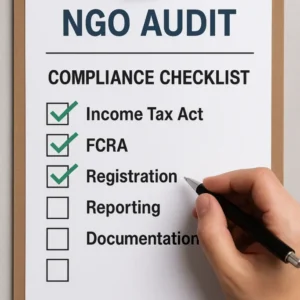
What Constitutes an NGO Audit?
An NGO audit involves a systematic review of financial records, compliance with laws such as the Income Tax Act and FCRA, and donor-specific conditions. It is usually conducted by a qualified Chartered Accountant.
Income Tax Compliance: Audits are mandatory if the NGO’s income (before exemptions under Sections 11 & 12) exceeds ₹2.5 lakh in a financial year. The audit report must be filed in Form 10B by September 30 of the assessment year.
FCRA Audit: NGOs receiving foreign funds must maintain separate records and undergo an FCRA audit, with annual submission of Form FC-4 and audited statements to the Ministry of Home Affairs.
Who Needs an NGO Audit?
- Charitable Trusts, Societies, and Section 8 Companies with income exceeding ₹2.5 lakh in a financial year (before claiming exemptions under Sections 11 & 12 of the Income Tax Act).
- Section 8 Companies – statutory audit is mandatory irrespective of income.
- NGOs registered under FCRA – annual audit and reporting required for foreign funds.
- Donor-funded projects that mandate independent audits.
Why NGO Audit is Important
- Builds trust with donors, beneficiaries, and regulators
- Ensures compliance with tax, FCRA, and governing laws
- Prevents misuse or misallocation of funds
- Strengthens internal controls and governance
- Required for 80G / 12A approvals and funding eligibility
Documents Required for NGO Audit
- Registration certificate and governing documents (Trust Deed, MoA, AoA)
- Income Tax registration certificates (12A, 80G)
- Financial statements – Balance Sheet, Income & Expenditure Account
- Bank statements and cash book
- Donation/grant receipts and donor agreements
- Fixed asset register
- FCRA registration certificate (if applicable) and FCRA bank statements
- Proof of utilization of grants and project expenditure reports
- Previous year’s audit report and ITR filings
Consequences of Non-Compliance
- Loss of 80G / 12A status and tax benefits
- Cancellation of FCRA registration for foreign funding
- Penalties, interest, or legal proceedings under tax laws
- Loss of donor trust and funding opportunities
Our NGO Audit Process
- Understanding the NGO’s Structure & Activities
We review your organisational setup, projects, and funding sources. - Review of Financial Records
Examination of receipts, payments, assets, and liabilities. - Compliance Verification
Checking adherence to Income Tax Act, FCRA, donor agreements, and internal policies. - Reconciliation & Fund Tracking
Matching bank transactions, donation records, and grant utilisation statements. - Internal Control Assessment
Evaluating financial management systems and recommending improvements. - Reporting
Issuing a detailed audit report with findings, compliance status, and corrective measures.
FCRA Rules 2025: Key Updates
- NGOs must report foreign donations, donor details, purpose, and remittance within 7 days on the FCRA portal.
- Maintain a dedicated FCRA bank account; auditors review monthly reconciliations.
- Cap on administrative expenses at 20%; advance approval needed for changes.
- Annual audited statements must be uploaded on both the NGO’s website and FCRA portal.
- These measures enhance transparency and reduce misuse of foreign funding.
We’re Here.
Need an Advice from Expert CA?
Let’s Connect Today!
- (+91) 9403668809
Contact Detail
- Near Signal Point, Bhadgaon Road, Chalisgaon, Maharashtra
- cashubhamguptacsn@gmail.com
Practice Area
Accounting & Bookkeeping Services
Taxation Services (Direct & Indirect Taxes)
Auditing & Assurance Services
Company Registration & Compliance
(ROC Services)
Financial Advisory & Business Consulting
- cashubhamguptacsn@gmail.com
© 2026 CA Shubham Sudhir Gupta & Co. | All rights are Reserved